
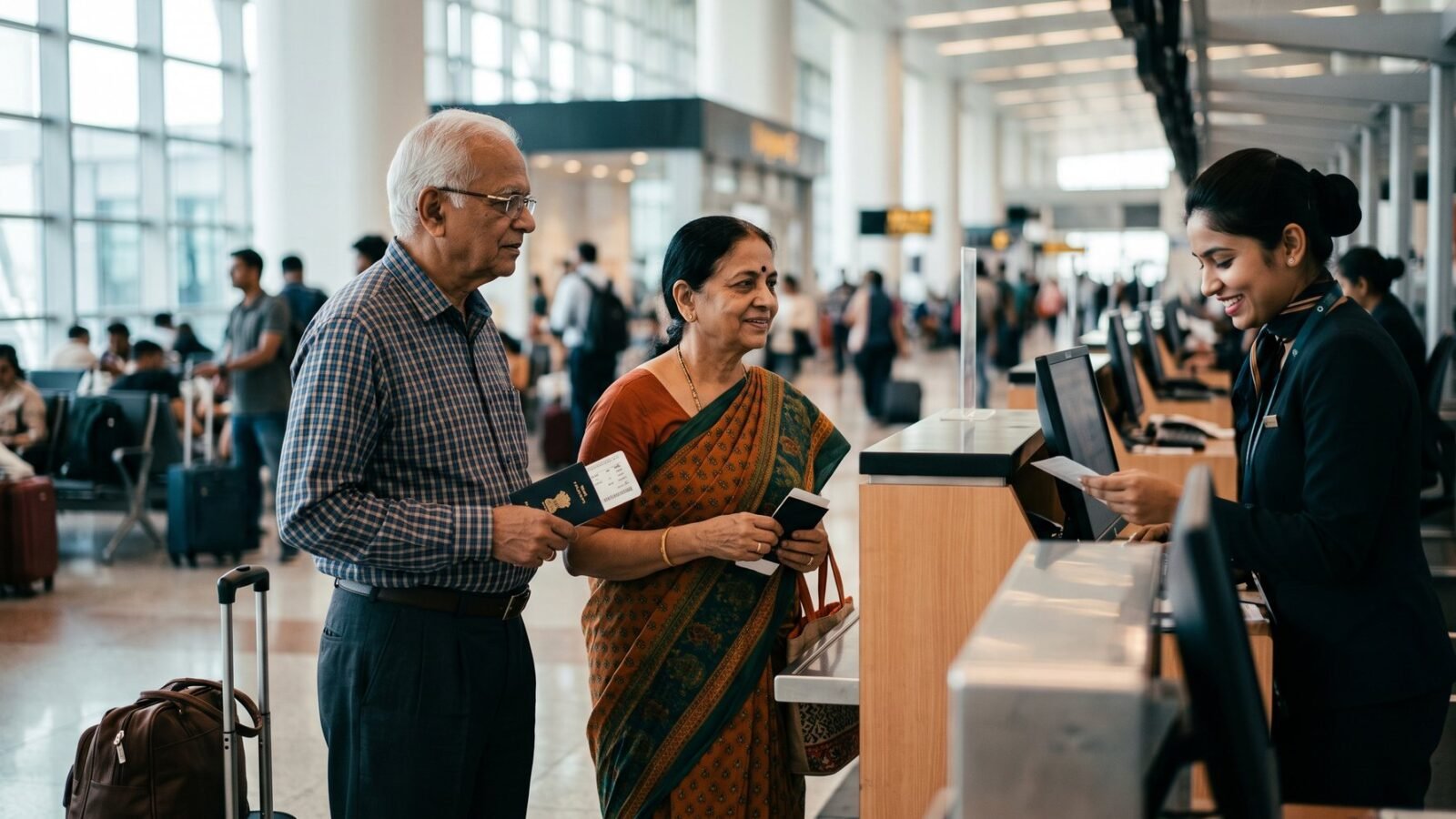
What counts as an unaccompanied minor on a flight to India
A child travelling without a parent or guardian in the same cabin, carried under the airline’s own supervised program from the check in desk to a named adult at the other end. That is the whole definition. The variation is all in the ages.
Air India treats children aged 5 to 11 as unaccompanied minors and the service is mandatory for them, while 12 to 17 year olds may use it if the family wants it. United requires it from 5 to 14 and makes it optional to 17. Emirates will not carry a child under 5 alone at all, requires its service from 5 to 11, and lets 12 to 15 year olds travel on an adult fare with paid assistance available. Etihad’s program runs 5 to 17. Qatar Airways starts at 5, though published sources disagree on whether the ceiling is 15 or 17, so we confirm that one against the airline for the date you are flying.
Two things hold everywhere. A child under 5 does not fly alone. And the age that counts is the age on the travel date, not the booking date, which catches out families who book six months ahead around a birthday.
Connecting itineraries are the hard part, not the flight
The long flight is the easy part. A child in the program is seated near the crew, checked on, handed over.
What breaks is the transfer between airlines. Air India’s service generally applies only where every segment is operated by Air India. United’s covers nonstop flights on United and United Express and does not extend to an itinerary that connects onto a partner carrier. Read those two rules together and a very common shape of India booking stops working: a domestic feeder on one airline, the long haul on another, an Indian domestic hop on a third. Each carrier supervises its own aircraft. Nobody owns the handover in between.
So a nonstop, where one is operating on your dates, is worth more on a child’s ticket than on anyone else’s. Failing that, the routings that hold up are the ones where a single carrier operates every leg and one airline is accountable end to end.
Airlines also cap how long a connection can run before they will accept a supervised minor on it. Under six hours is the figure most often cited. It varies enough by carrier and by hub that we do not publish a number here, and we ask the operating airline about your specific routing instead.
If a connection is missed, the airline keeps the child in its care and rebooks. No child is left at a gate. The receiving adult in India may end up waiting a very long time, so both named custodians have to be reachable by phone for the whole journey. We will also tell you when the cheapest itinerary on the screen is one we would not put a nine year old on.
Fees, and why there is no number on this page
Every carrier charges for this, either as a flat fee per direction or built into the fare, and the amounts move.
Air India has introduced new unaccompanied minor handling fees on international routes including the US. United charges a flat fee each way, with reduced pricing for a second sibling. Emirates includes the service in the adult fare for its mandatory band and charges for the optional one. Etihad charges less, or nothing, when the service is arranged in advance rather than on the day of travel.
We are not printing those figures. Our research on unaccompanied minor fees came from secondary sources rather than the airlines’ own current fee schedules, and a fee quoted wrongly is a fee you argue about at a check in counter with a child standing next to you. When you message us we read the operating carrier’s live policy for your route and tell you what it costs that day, alongside the fare.
Two rules do hold. Arranging the service at booking is almost always cheaper than arranging it at the airport, and on some carriers arranging it at the airport is not possible at all. And places are capped per flight, so a child cannot be added to a flight that has already filled its allocation, however many seats are still for sale.
The paperwork and the handover at both ends
Airlines run this on forms and named people, not goodwill.
Expect to complete the carrier’s unaccompanied minor form, naming the adult dropping the child off and the adult receiving them, with full addresses, phone numbers and photo identification details for both. Air India is commonly cited as wanting four copies for a direct flight and six for a connecting one. Passport copies are required, and the child needs their own passport and, where it applies, their own visa or OCI card.
The adult who drops the child off cannot leave the airport until the aircraft has actually departed, not just boarded. If the flight returns to the gate, the airline hands the child back to whoever is named on the form.
At the India end the receiving adult must be the person named on that form, must be there, and must bring the identification recorded on it. An uncle who turns up instead of the named grandfather will not be given the child. Changes go through the airline before departure, not through a phone call at arrivals.
Medication travels in the cabin bag with its prescription, and say so at check in. Crew will not administer anything. They will know it is there and who is carrying it.