
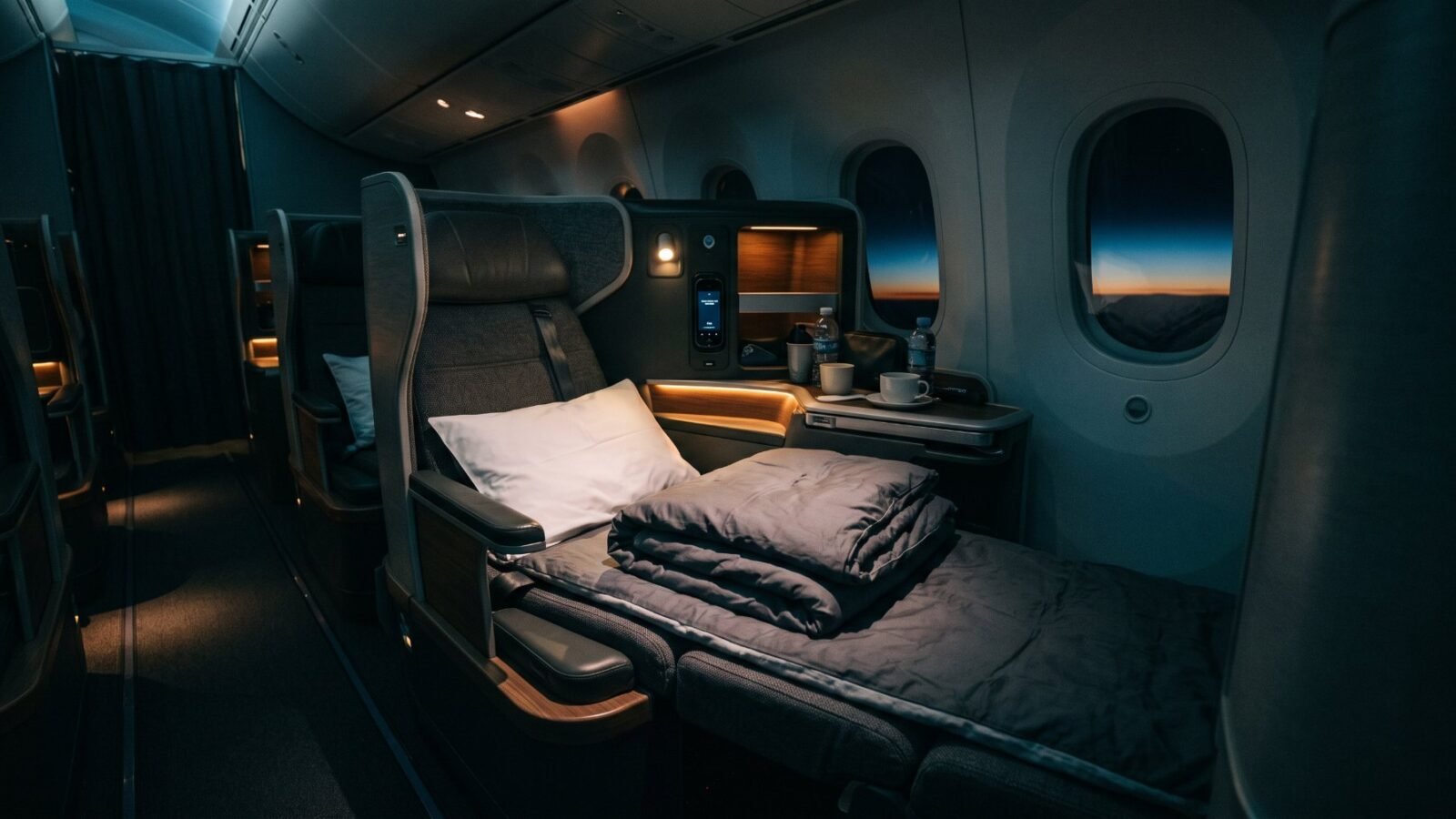
The honest answer depends on who is in the seat
We sell business class tickets, so treat this section with the scepticism it deserves.
It is worth it when the flight is the hard part of the trip. Fifteen hours in the air with an eight hour time difference waiting at the end is a physical event, not a journey. If you are over seventy, if your back is bad, if you cannot sleep sitting upright, if you are flying to a funeral or to a wedding where you have to function on the day you land, the bed is doing real work.
It is not worth it when the flight is just the boring part. If you sleep anywhere, if you have a spare day at the other end, if the trip is six weeks long and a rough first night is a rounding error, the money buys more in India than it does in the air.
The version we hear most is a family sending two elderly parents out and back. The answer there is frequently business for the parents, economy for the adult children. Nobody feels good about it at the check in desk. Everybody is glad of it at hour eleven.
Lie flat is not uniform, especially on Air India
Business class covers a wider range of physical seats than a fare comparison lets on. This is where people get disappointed.
Air India’s product varies by aircraft. Newer 787-9s delivered with the current cabin have 1-2-1 suites, fully flat beds, aisle access from every seat, privacy doors. Refurbished 777-300ERs coming through the retrofit programme are 1-2-1 and fully flat too. Older 787-8s that have not been retrofitted are 2-2-2 with angled flat beds, so you sleep on a slope and a window passenger climbs over a neighbour to reach the aisle. Both are sold as business class, sometimes on the same route in the same week.
United’s Polaris, used on its India flying including the Washington Dulles to Delhi nonstop, is 1-2-1 reverse herringbone, full lie flat, direct aisle access from every seat across the aircraft types it runs in this market.
If flat is the reason you are paying, ask which aircraft is scheduled, and know that it can be swapped. We check when we quote, and we say so when the answer is angled rather than flat.
Not every business fare buys the same thing
Business class used to be one product per cabin. It is drifting toward the fare tiering that happened to economy a decade ago. United introduced a lower cost Basic Polaris tier in 2026, a stripped down version of the same cabin. The seat is the seat. The fare carries fewer of the things around it, and two passengers side by side in Polaris can hold quite different tickets.
Baggage diverges too. Business allowances are more generous than economy, commonly two heavier bags rather than two standard ones, but the figures differ by carrier and by fare and our research could not confirm them per carrier on this corridor. What is printed on your own ticket governs. Lounge access is generally included, the quality varies enormously, and the Gulf carriers are widely regarded as the strongest. That matters on a seven hour connection at Doha and very little on a nonstop you reach ninety minutes before departure.
Discounted business fares are the honest reason to ask an agency rather than only checking an airline website. Business seats go through the same negotiated channels as economy seats, and a discounted business fare commonly sits well below the published fare for the same seat on the same aircraft. What it does not change is the fare rules. Change rules can be tighter, cancellation penalties stack, and mileage accrual depends on the fare basis. If you are buying business partly for the miles, ask about accrual first. On some fares the answer is nothing at all.
The case for premium economy
Premium economy is the option most people skip past, and on this route it is often the right answer.
More legroom and seat width, a deeper recline, better catering, usually a larger baggage allowance, at a price closer to economy than to business. It is not a bed. If your problem is that you cannot sleep sitting up, premium economy does not solve it.
But a lot of what makes economy hard over fifteen hours is not the sleeping. It is the knees, the shoulder space, the tray pushed into your chest when the person in front reclines. Premium economy fixes those, and for a traveller in their fifties or sixties who is uncomfortable rather than in pain it delivers most of the benefit for a fraction of the step up.
On some carriers and some dates the gap between premium economy and business narrows enough that the bed becomes the better buy. On others premium economy sits barely below business for a seat that is nothing like it. We will say when it is not worth its own premium on your dates.
The case for not paying
Plenty of people ask us about business class and end up better served by economy and a few targeted fixes.
An exit row or a bulkhead solves legroom. A night departure rather than a morning one solves sleep timing better than any seat does. Paying to assign a pair of seats at the back of a cabin, where rows are often less full, is a real strategy. A lounge day pass on a long connection removes the worst hour of the trip for a fraction of a cabin upgrade.
Then there is the nonstop question. Where a nonstop is operating on your dates, economy nonstop against business with a connection is a close call. The connection adds hours, a second takeoff and landing, a terminal transfer and the risk of a missed link. A flat bed on the long leg is a real gain. So is being on the ground eight hours earlier. For an elderly traveller flying alone we favour fewer connections over a better seat, because the airport is harder than the aircraft.
We would rather you spent the difference in India than with an airline.