
Lap infant or a paid seat: where the line falls
A lap infant is a child who has not turned two by the date of the flight. Airlines set their own minimum at the other end, commonly a few days old, and some want a doctor’s note for a newborn.
The line applies per flight, not per trip. A child who is one on the outbound and turns two in India needs a paid seat on the way home. Families find this out at the return check in counter more often than you would think, and by then the flight is full and the seat is expensive.
A child with their own seat gets their own fare, their own baggage allowance, and on most carriers the option of an approved car seat at a window. On a night flight to Delhi, a toddler asleep in a car seat is a materially different trip from a toddler asleep on you for eight hours.
We ask two things before quoting. How old the child will be on the return date, and whether you are flying with another adult. A parent alone with a lap infant and a toddler for fifteen hours is a specific situation, and the seat map matters as much as the fare does.
What an infant ticket actually costs
An infant on the lap is not free on an international ticket. The convention across long haul carriers is a percentage of the applicable adult fare, plus taxes and surcharges in full.
We are not putting a figure on that percentage. It gets quoted as a round number across the industry, but our research confirmed it for one North American carrier and not for Air India, United, Emirates, Qatar Airways or Etihad on this corridor. So we price your actual ticket and tell you what the infant costs on it.
The tax side is what surprises people. Taxes and surcharges on an India itinerary are not discounted the way the base fare is, so the infant portion of a family booking is rarely as small as expected. Baggage is the other half of the sum. A lap infant does not get a full checked allowance on most carriers, while a child in their own seat generally gets the adult one. If you are going for two months and packing accordingly, that difference closes a fair part of the gap.
Bassinets are a request, not a booking
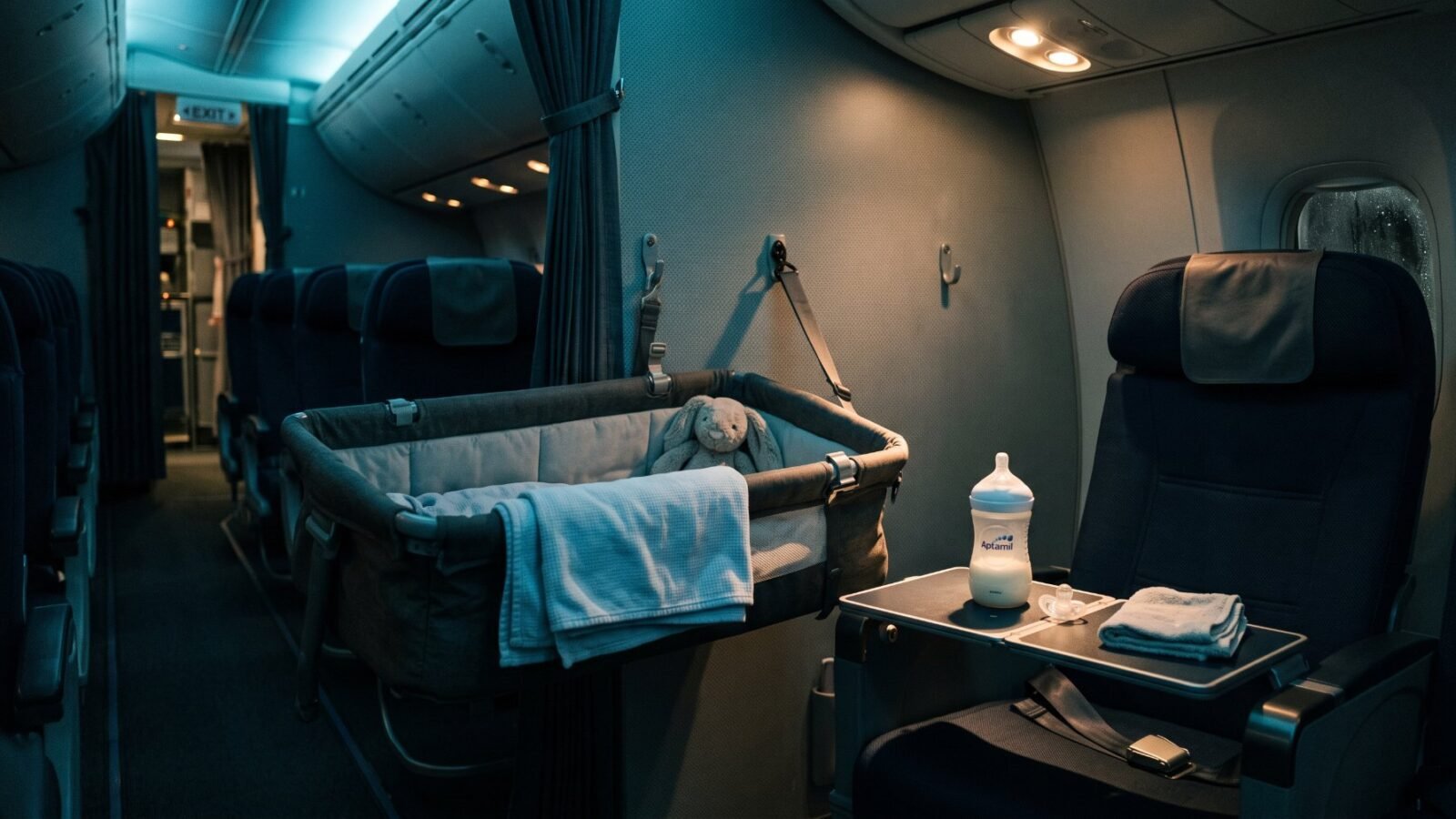
A bassinet fixes to a bulkhead wall, so it can only go at a bulkhead row. Everything else follows from that.
There are a handful of positions on any aircraft. The airline allocates them, usually first come first served, and they are not confirmed the way a seat is. Request one at booking, request it again directly with the airline, reconfirm it. The common advice is at least 48 hours out, which is fine on a Tuesday in February and nowhere near enough on a festive season flight to Delhi.
Bassinets also have limits, somewhere in the range of 15 to 25 pounds and under roughly 18 months, varying by airline and by aircraft type. A 777 and a 787 on the same route can carry different hardware. We could not confirm precise limits per carrier and per aircraft, so we ask the airline about your specific flight rather than quote a number that might not apply to it.
A bassinet cannot be used during taxi, takeoff, landing or turbulence. And a bulkhead row with no bassinet in it is still worth having with a small child, for the floor space.
Documents for a baby, including the consent letter question
Every passenger on an international flight needs a passport, a lap infant included. Airlines may ask to see it at boarding, not only at check in. An infant travelling on a parent’s passport is no longer how this works.
Airlines may also ask for a birth certificate as proof of age, particularly for a child close to the second birthday, because the lap fare turns on that date. Carrying a copy costs nothing.
Consent is the harder question. Where a child travels internationally with only one parent, or with a grandparent or another guardian, a notarised consent letter or no objection certificate from the non travelling parent is commonly requested. That requirement is driven by immigration rules rather than by the airline, and it differs by country and by situation, including where a parent is deceased or has sole custody.
We want to be careful here, because the sources we found on this are travel industry blogs rather than official immigration guidance, and the consequence of getting it wrong is a boarding denial. If you are flying to India with a child and without the other parent, confirm the current position with US Customs and Border Protection or the Canada Border Services Agency for your departure, and with India’s Bureau of Immigration for your arrival. Carrying a notarised letter you did not strictly need is a small cost. Not carrying one you did need is a missed flight.
Booking around the child rather than the fare
The cheapest itinerary and the right itinerary are rarely the same one when there is a baby on the ticket.
Departure time matters more than total journey time. A flight that leaves late evening and puts a toddler to bed at roughly the normal hour is worth a great deal, even at a longer total travel time. A ninety minute connection is theoretically fine and practically brutal with a pram, a nappy change and a terminal transfer, so we will usually push a family toward the longer layover. And where a nonstop is operating on your dates it is worth more with a small child than the fare difference suggests, because it removes a whole cycle of deplaning, walking, waiting and reboarding.
Gate checking a stroller usually works for a compact folding model and not for a large travel system. At some airports you collect it at the aircraft door. At Delhi, expect the belt.