
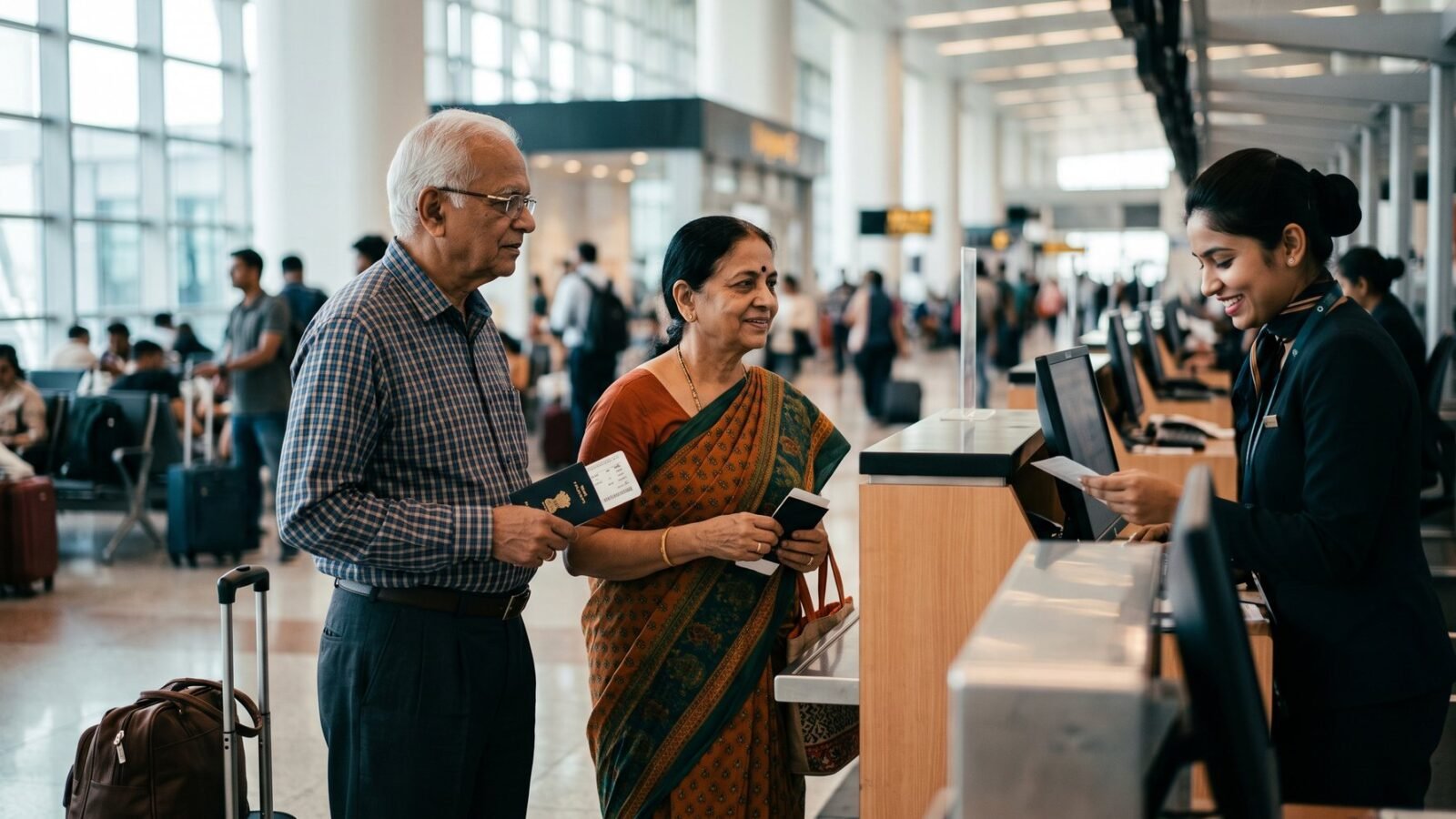
There is no unaccompanied senior service
Families usually find this out late. Airlines run structured unaccompanied minor programs for children, from around age five upward depending on the carrier, with a signed handover and staff responsible for the child between gates. No carrier flying US and Canada to India offers anything equivalent for older adults.
What exists instead is standard special assistance, sometimes called disability or mobility assistance. It is real, it is regulated on flights touching the US, and it is free. It is also a series of handoffs between ground staff rather than one person accompanying your parent for eighteen hours. Nobody sits with them. Nobody explains a gate change unless your parent asks.
So the job is not to find a product that does not exist. It is to build an itinerary with fewer moments where your parent is alone and has to solve something, and to file the requests that put staff at each of those moments.
What to request, and what the codes mean
Airlines use three codes for mobility assistance. The wrong code produces the wrong equipment and the wrong staffing.
- WCHR, wheelchair to ramp. Walks short distances and manages steps, cannot cover terminal distances. Right for most older travellers who are otherwise mobile.
- WCHS, wheelchair to steps. Cannot manage stairs or a jet bridge slope, but moves around the cabin once seated.
- WCHC, wheelchair to cabin. Cannot walk at all, and must be taken right to the seat.
Ask for the code that matches the airport, not the house. A parent who walks comfortably at home may still be unable to cover the distance from immigration to a far gate at Delhi or Dubai inside a connection window. Tell the airline separately about limited English, hearing loss or memory difficulties. Staff may not interrogate the nature of a disability, so they act only on what they are told.
The 48-hour window
Every major carrier on these routes asks for special assistance requests at least 48 hours before departure, through the booking, through Manage Booking, or by phone. Requests made later are usually still accepted, but they are handled on a best-effort basis rather than as a confirmed arrangement. Treat 48 hours as the line between a booked service and a hope.
File at booking if you can. Then, and this is the step families skip, call the airline to confirm it is showing on the reservation, and ask for it on every segment, including any codeshare leg operated by a different airline. A request entered in one carrier’s system does not reliably reach another’s.
Check it again three or four days before departure. Reissued tickets, schedule changes and equipment swaps drop assistance requests off a record without anyone being told. A two minute call is cheaper than finding out at a check-in desk in Newark.
TSA Cares, and file it first
Departing from a US airport, TSA Cares is a free help line for travellers with disabilities, medical conditions or other circumstances that make screening difficult. It covers international departures, not only domestic ones, which is where people get it wrong. A Passenger Support Specialist can meet the traveller and walk them through screening.
Requests go in at least 72 hours before departure, through the TSA online form or the help line on 855-787-2227. That is more notice than the airline’s 48 hours, so this is the one to file first.
Travellers aged 75 and over also get modified screening in the US, including keeping shoes and a light jacket on in most circumstances. Departing from a Canadian airport, the equivalent goes through the airline and that airport’s screening authority rather than through TSA. Ask the airline what it files on your behalf and what you arrange separately.
The connection is where it goes wrong
Almost every difficult story a family tells happens at the hub, not on the aircraft. Dubai, Doha, Abu Dhabi, Frankfurt and London are enormous. A transfer can involve a train, a long walk, a second security screening and a gate that moves.
Book a longer connection than the minimum. Ninety minutes is legal, not comfortable, and for a passenger who cannot hurry it is a bad trade. Request assistance for the transfer itself, since it is a separate service at a separate airport, usually delivered by a ground handling company. Where two airlines are involved, confirm with both: US regulator guidance is explicit that accessibility needs should be confirmed with every airline on a multi-carrier itinerary.
Keep the whole journey on one ticket where you can. On a single ticket, a missed connection is the airline’s problem: it rebooks your parent onto the next available flight and arranges the assistance to get them there. On two separate tickets nobody owes them anything, and they are standing at a counter in a foreign airport at three in the morning.
What they carry, and what they know
Write the airline’s local number, the booking reference and your own number on a card in their wallet, not only in a phone that may be flat. Make sure the phone works abroad and that they will answer a call from an unknown number. Tell them plainly: if anything is unclear, stay at the gate and phone you, rather than trying to solve it by walking. If you booked through us, they can call us instead.
Medication travels in the cabin, in original labelled packaging, with enough for several days beyond the scheduled trip and a written list of generic names and doses. For injectables, controlled substances, oxygen or a battery-powered mobility device, tell the airline in advance and ask what it wants in writing. Check passport validity against the destination’s requirement, not the departure date.
Then the small things: an aisle seat near the front, a printed itinerary in large type, a written note of who is meeting them and where. None of it is sophisticated. It is the difference between a long day and a frightening one.
If the worry is memory rather than mobility, none of this covers it, and a paid travel companion is the honest option. Those services are a private market, not an airline product, and you are usually funding the companion’s own return fare.