The clock, stated plainly
The clock that matters is the family's: the grandchild being born, the medical appointment in India, the visit that cannot wait another year. Alongside it sits one operational deadline, and it is the airline's rather than ours. Special assistance should be filed at least 48 hours before departure, and inside that window it is accepted on a best effort basis rather than guaranteed. We will tell you which of the two is actually pressing on your booking. We will not manufacture a third.
The timing that matters here is not the fare curve. It is the 48 hour assistance window and the connection you end up with. Book with a few weeks in hand and we can choose a routing with a humane layover rather than the cheapest possible connection, file the request with each carrier, and have it confirmed before departure. At the last minute all three get harder, and the fare is the least of it.
The 48 hour window, which is the date that actually matters
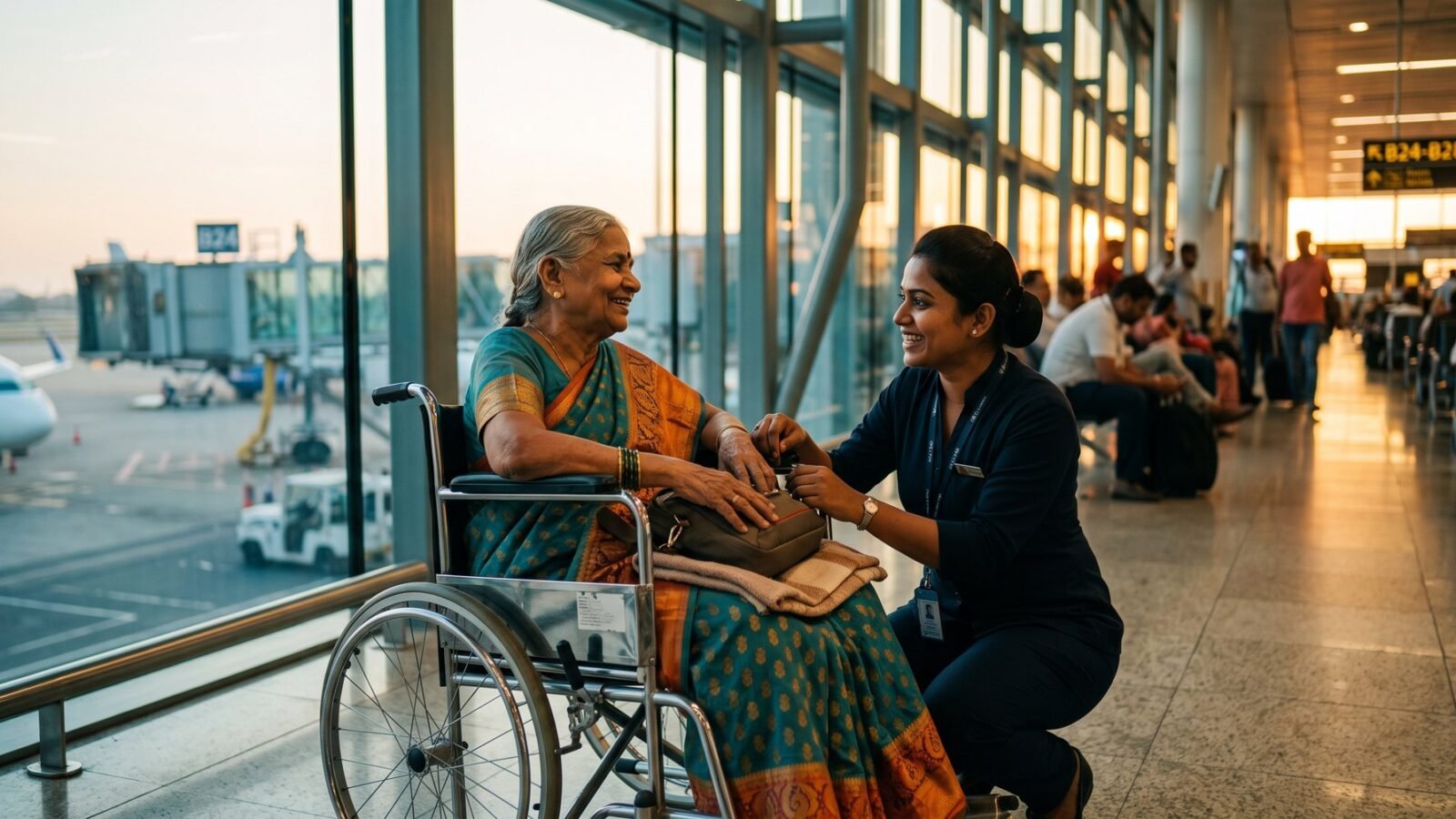
Every airline on these routes asks for wheelchair and special assistance requests at least 48 hours before departure. Inside that window requests are usually still accepted, but handled on a best effort basis rather than guaranteed. So the practical deadline on a senior booking is not the fare. It is filing the request and getting it confirmed. We file it with every carrier on the ticket and confirm back to you in writing.
Which code to ask for
Airlines use three. WCHR is for a passenger who can walk short distances and manage steps but cannot cover long airport distances. WCHS is for someone who cannot manage steps but can move about the cabin unaided. WCHC is for someone who needs to be taken all the way to their seat. Describe what is true rather than what sounds least troublesome. A WCHR request for a passenger who needed WCHC is the usual cause of a bad connection.
Connections are where assistance breaks down
On a one stop through Dubai, Doha, Abu Dhabi, London or Frankfurt, the request has to reach every airline involved, not only the one that issued the ticket. Ground assistance at a hub comes from the airport’s handling contractor, not the airline. Long walking distances and tight connections are the real risk for an older traveller flying alone, so we look at connection length before price.
What the rules guarantee, and where they stop
On flights to and from the US, the Air Carrier Access Act requires airlines to provide wheelchair and guided assistance from the terminal entrance through security to the gate and to the seat, and the reverse on arrival, at no charge. A passenger who is not independently mobile must not be left unattended for more than 30 minutes. Every airline must make a Complaints Resolution Official available at no cost. Those rules cover flights touching the US. A segment flown entirely outside the US is governed by the operating airline’s own policy and the local regulator instead.
You still have to say so at the airport
A note on the booking does not tell the staff on duty who to look for. The passenger, or whoever is seeing them off, has to identify themselves at check in and again at the gate. Passengers who need extra time to board are entitled to board first if they self identify. In the US, TSA Cares provides screening assistance, including eased screening for travellers aged 75 and over, and asks for at least 72 hours notice on 855-787-2227.
Travelling with a wheelchair of your own
Arrive an hour before the normal check in cutoff. If it is powered, register the battery type and specification with the airline in advance. Tell us at booking so it is on the record from the start rather than at the counter.
How to reach us
WhatsApp, or 1-833-330-0574 for the US and Canada, answered 24/7, whatever your time zone.
Questions people actually ask
How far in advance do I need to request a wheelchair?
At least 48 hours before departure, with every airline on the ticket rather than only the one you booked through. Requests made inside 48 hours are usually still accepted, but on a best effort basis rather than guaranteed, and that is the difference that shows at a busy hub. We file at booking and confirm back to you. If you booked elsewhere and nobody filed it, call the airline today.
Does the wheelchair assistance carry over at Dubai, Doha or Heathrow?
It should, but only if it was requested with each airline on the itinerary. On a multi carrier ticket, the assumption that one request covers every leg is where things go wrong. Ground handling at the hub is done by the airport's contractor rather than the airline, and short connections are the pressure point. We look at connection length before price.
Is there a charge for wheelchair assistance?
No. On flights to and from the US the Air Carrier Access Act requires airlines, including foreign carriers, to provide wheelchair and guided assistance from the terminal entrance through security to the gate and to the seat, and the reverse on arrival, at no charge. The same holds in practice on Canadian departures under Canadian accessibility rules. If someone asks you to pay for basic airport assistance, query it. It is not a standard charge.
What if the assistance does not turn up on the day?
Ask for the airline's Complaints Resolution Official. Every airline operating to or from the US must make one available at no cost, in person at the airport or by phone, and they are trained on disability accommodation. A passenger who is not independently mobile must not be left unattended for more than 30 minutes. Tell us afterwards too. We log which carriers and airports actually deliver on their filings.
Are there real senior discounts on flights to India?
They are limited and vary by carrier and by residency, so we check where one applies and quote the better of that and our consolidator fare. We will not promise a senior discount before looking at your route and dates. Worth knowing as well: there is no standard escorted service for older adults comparable to the unaccompanied minor programmes airlines run for children. What exists is special assistance, and it is free.